

Australia is often described as a country with a strong quality of life, yet recent data suggest that something important is shifting inside workplaces. The State of the Global Workplace 2025 report (Gallup) reveals that thriving in Australia and New Zealand has fallen to 56 percent, the lowest point in more than a decade.
Thriving, as defined by Curtin University, is more than simply “feeling good.” It is a sustainable state of psychological wellbeing that brings together:
- vitality: emotional and physical energy
- growth: a sense of progress, learning, and purpose
When people are thriving, they think clearly, collaborate well, and recover from stress more easily. When thriving weakens, motivation, problem solving, and connection decline too.
After reviewing the Gallup report and current scientific evidence, three key factors appear to be driving this downward trend.
1. High stress levels: the spark that starts the cycle
Gallup reports that almost one in two employees in Australia and New Zealand experienced “a lot of stress” the previous day. This is noticeably higher than the global average of 40 percent.
From a neuroscience perspective, this matters.
When stress is frequent or prolonged, the body releases more cortisol, a hormone that prepares us to respond to pressure. In short bursts, cortisol is useful. But when levels stay high for too long, it becomes harder to:
- regulate emotions
- concentrate
- think flexibly
- sleep well
- recover at the end of the day
Many people describe this as feeling “switched on” even when the workday is over.
In workplaces, this can show up as shorter attention spans, reduced creativity, and increased reactivity, well before burnout becomes visible.
2. A steady rise in difficult emotions
The Gallup report shows that in Australia:
- 20% feel sadness every day
- 15% feel anger
- 12% feel loneliness
These emotions provide useful information.
- sadness can reflect depletion or exhaustion.
- anger can point to frustration or blocked progress.
- loneliness often signals a lack of meaningful connection or support.
When these emotional states repeat day after day, they indicate that current demands are exceeding available resources. The nervous system remains on alert, making it harder to recover and maintain wellbeing. Over time, these repeated emotions contribute to the erosion of thriving.
3. Declining engagement: when work becomes an obligation
Engagement levels in Australia and New Zealand show a clear pattern:
- 23% of employees feel engaged
- 62% complete their tasks out of obligation
- 15% are actively disengaged
Many employees feel distant from the purpose of their work. They are functioning, but not feeling connected. This form of “doing the job but feeling flat” reduces:
- resilience
- initiative
- creativity
- problem-solving
- collaboration
In modern organisations, emotional engagement is a core element of effective teamwork and sustainable performance.
How these factors combine: the downward cycle
Across the data, a consistent pattern emerges:
High stress → difficult emotions → reduced engagement → lower thriving → lower performance
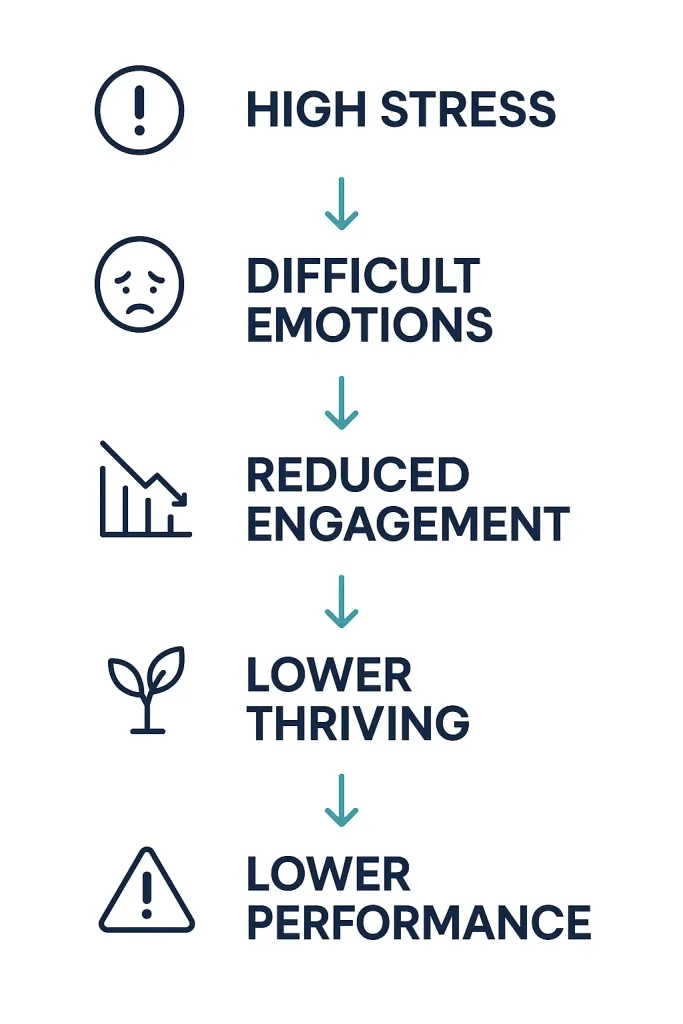
Many employees describe this inner experience as: “I’m getting things done, but I don’t feel well inside.”
This cycle does not resolve on its own. It requires organisational attention, leadership that understands emotional signals, and wellbeing strategies that are grounded in evidence and go beyond surface-level programs.
Why organisations need to act now
This is not simply an individual wellbeing issue. It is a strategic organisational risk. The consequences of ignoring it include:
- higher turnover
- decreased productivity
- reduced innovation
- poorer workplace climate
- increased burnout risk
- more mental health challenges
- higher absenteeism
Supporting people to thrive requires environments that protect energy, enable recovery, and strengthen purpose and meaningful connection. Approaches grounded in neuroscience and psychology, combined with leadership that understands emotional cues, can help restore clarity, connection, and sustainable motivation.
EQness specialises in helping organisations apply these principles in practical and evidence-based ways. Through our work with leaders and teams, we help build cultures that enhance emotional insight, reduce psychological load, and create the conditions for clear thinking, healthy relationships, and resilient performance.
If your organisation is ready to strengthen wellbeing with science-informed guidance and tailored support, we would be glad to assist.
Further reading
- (2025). State of the Global Workplace 2025: The Voice of the World’s Employees. Gallup Press.
- Cham, B., Jorritsma, K., Griffin, M., & Parker, S. K. (2023). Thriving Sustainably: Navigating the Complex Landscape of Workplace Mental Health – A Thrive at Work Survey Insights Report. Curtin University. Available at: https://www.thriveatwork.org.au/wp-content/uploads/2023/10/Thriving-Sustainably-A-Thrive-at-Work-Survey-Insights-Report.pdf
- Australian Institute of Health and Welfare (AIHW). (n.d.). Stress and trauma. Available at: https://www.aihw.gov.au/mental-health/topic-areas/health-wellbeing/stress-and-trauma

Dr Olga-Lucía Gamboa — PhD, MPsych
Cognitive neuroscientist, psychotherapist and certified mindfulness teacher with over 15 years of experience in brain research. Founder of EQness, where she helps individuals and organisations enhance wellbeing through science.