

The exhaustion that goes unnoticed is often one of the clearest signs of stress. Here is what may be happening beneath the surface.
You keep answering messages. You keep showing up to meetings. You keep holding everything together. From the outside, nobody would think anything is wrong.
And that is the trick: when stress sticks around, it gets very good at hiding. The earliest physical signs of stress are often the ones we stop noticing.
We tend to think exhaustion announces itself. That there will be a clear moment when the body says, “Enough.”
But it rarely works that way.
The exhaustion that catches people out is usually quiet. It builds slowly beneath a life that keeps functioning, and often the last person to notice is you.
And it is not because you do not know yourself well enough. It is, in part, how we are wired.
How Stress Affects the Body
When something demanding shows up — a deadline, an uncomfortable conversation, the feeling that too many things depend on you — your body gets ready.
Your heart beats a little faster. Your attention narrows. Energy seems to appear from nowhere.
This is a remarkable system, and it is on your side.
Ideally, once the challenge has passed, everything settles again. That return to calm is the important part.
And it is exactly the part that modern life interrupts over and over again: just as things start to settle, something else arrives.
Bruce McEwen, a stress researcher, had a useful way of making sense of this. He believed that what really wears us down is usually not the big dramatic event, but the accumulation of hundreds of small daily demands that keep us slightly switched on for longer than we were meant to be.
He called it allostatic load.
You can think of it as carrying a backpack and adding one small stone at a time. None of them feels particularly heavy. But one day you realise you have been carrying the weight for hours and have not been able to put it down.
Early Physical Signs of Stress
Here is the interesting part.
As the body becomes used to stress and the tension that comes with it, it stops treating it like an alarm. It starts to feel normal.
It is like living next to a railway line: eventually you stop hearing the trains.
Which means the first signs rarely arrive as a clear thought: “I am exhausted” or “I am stressed.”
They arrive as physical sensations you have been carrying for so long that you barely notice them anymore.
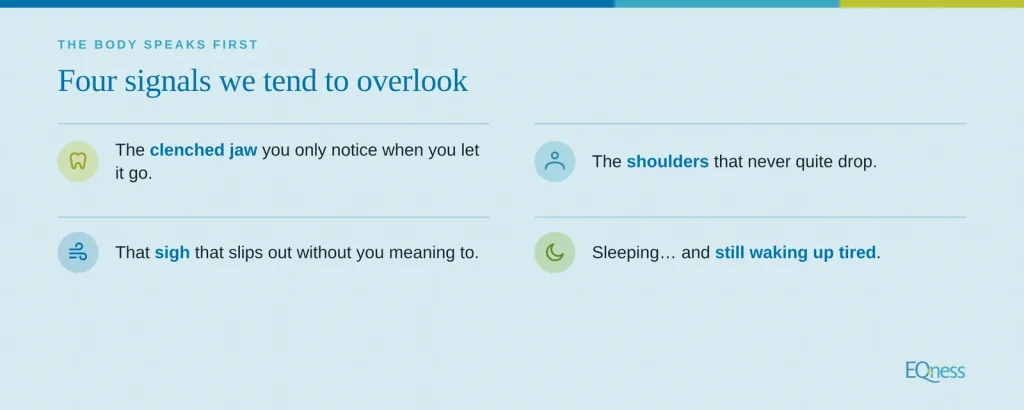
The jaw is one of the places where this shows up most clearly.
Under pressure, the jaw muscles tighten almost without you realising it. Studies have shown that stress increases activity in these muscles (Glaros & Rao, 1979). That is one reason so many people clench their teeth during the day without noticing — something that has been linked repeatedly to stress and anxiety.
The signal is often this simple: you only realise your jaw was tense when, for a moment, you let it go.
The neck and shoulders behave in much the same way. They tighten as though you are preparing for a fight that never arrives — and then stay that way for hours.
The same response that once helped our ancestors deal with real danger can now be triggered by something as simple as an email.
That is why so many of us carry a lingering ache in the neck or shoulders without quite knowing where it came from.
And then there is the sigh, which happens to be one of my favourite examples.
It turns out that sighing is not just a sign of boredom or sadness. It is a kind of reset that the body performs when breathing has become disrupted.
Research by Elke Vlemincx found that people sigh more when they are tense, and that a sigh is often followed by a small sense of relief (Vlemincx, 2010).
In other words, if you catch yourself sighing repeatedly without meaning to, it may be your body trying to calm itself down.
And then, of course, there is sleep.
You get to Friday and cannot seem to switch off. You sleep… and wake up feeling just as tired.
Not necessarily because you are sleeping too little. It is that your body is still operating in alert mode, even at night, and never quite gets the message that it can stand down.
The signal is not necessarily a thought. It may be your jaw, your shoulders, a sigh, or a night that leaves you just as tired as before.
Why It Is So Hard to See
Now, let us be honest about one thing: work stress does not affect everyone in the same way.
In a study that followed more than two thousand people over several years, researchers found that what took the greatest toll was not so much the amount of work itself, but the feeling of giving a lot and getting little in return (Liao et al., 2013).
That sense of imbalance, unfairness or lack of control can weigh just as heavily as the workload itself.
Not all exhaustion comes from the same place.
There is also the mental side of it, and it will probably sound familiar.
Small things suddenly feel overwhelming. You walk into a room and forget why you went there. Concentrating takes more effort than it should. You find yourself reacting more quickly than usual.
When researchers have studied people experiencing severe exhaustion, these are exactly the kinds of patterns that appear: more lapses in attention, poorer memory and greater difficulty concentrating.
Not for everyone, and not in exactly the same way. But the pattern shows up again and again.
And none of this means there is something wrong with you.
It is what happens when a system has been carrying a heavy load for a long time without the chance to put it down.
What Stress Leaves Behind
This is where things become more serious, but also more hopeful.
Because some of these changes can be seen in the brain.
A Swedish neuroscientist, Ivanka Savic, did something very straightforward: she put people experiencing severe work-related exhaustion into an MRI scanner and looked at their brains.
What did she find?
The areas involved in calm thinking and emotional regulation appeared slightly thinner, while the brain’s alarm system — the part that keeps us on guard — appeared larger and more reactive (Savic, 2018).
In other words: less braking, more acceleration.
Which is more or less exactly what it feels like when you are running on empty.
Recovery Is Possible
Savic scanned those same people again one or two years later.
And many of the changes had begun to reverse.
The areas involved in calm, reflective thinking appeared to have returned closer to where they had been before.
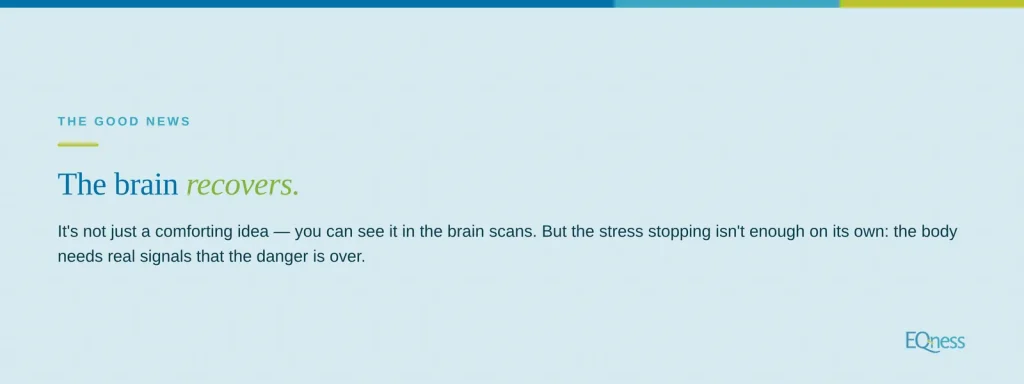
The brain can recover.
It is not just a comforting idea. You can see it in the scans.
But — and this matters — not everything returned to normal.
The brain’s alarm system still appeared somewhat enlarged even years later.
Recovery was not automatic. The people in the study were actively working on their wellbeing.
It was not enough for the stress to stop.
The body also needed the right conditions to settle and recover.
And that applies to the mind as much as the body.
A clenched jaw does not relax simply because you decide to relax. Neither does a tense neck.
The nervous system needs genuine signals that the danger has passed.
That is why something as simple as a slow, extended exhalation can help — essentially a deliberate version of that sigh.
You are speaking to the body in its own language, without needing to think your way there first.
Rest is not the reward you earn once everything is finished. It is part of how the brain restores the focus, patience and clarity that work asks of us.
And If It Is Not Just You
It is worth widening the lens to include the workplace.
When an entire team is operating like this, quietly and in the background, exhaustion rarely looks like exhaustion.
It looks like something else: people who seem disengaged, communicate poorly, or appear not to care anymore.
And often, it is none of those things.
It is capable people who are using up their resources faster than they can replenish them, and who have not had a genuine chance to recover.
And here we come back to that sense of imbalance.
What wears people down is not only the volume of work, but the feeling of giving a great deal and getting very little in return.
Someone who has given up and someone who has simply been carrying too much for too long can look remarkably similar from the outside.
They are not the same.
Understanding the difference matters. It helps us respond more effectively and create the conditions that allow people to perform well over the long term.
Recognising the Signs
None of this is a reason to panic.
Your body is not breaking down, and being exhausted does not mean you are damaged. But neither is it something we should normalise.
The goal is not to be alarmed, but to pay attention: to notice the small signals — many of them physical — before they become impossible to ignore.
And to treat rest for what it is: a necessity, not a luxury we keep postponing until there is finally time for it (which, somehow, there never is).
So it is worth paying attention.
Whether it is happening to you or whether you notice it in someone close to you.
Exhaustion that goes unnoticed is still exhaustion.
And the same body that learned to clench its jaw and carry tension in its shoulders can, given the right conditions, learn how to let go again.
One question to leave with you:
What is the first sign you have learned to recognise in yourself when you have been running on too little for too long?
More often than not, it is something physical — the jaw, the shoulders, a sigh.
And noticing it is often where the journey back begins.
Need a Helping Hand?
EQness offers psychotherapy, coaching, and workplace wellbeing training in Sydney, supporting individuals and organisations to manage stress, strengthen emotional regulation, and improve wellbeing and performance.
If stress, exhaustion, or burnout are affecting your life or work, please do not hesitate to reach out. We are here, to help.
References
McEwen, B. S. (1998). Protective and damaging effects of stress mediators. New England Journal of Medicine, 338(3), 171–179.
Glaros, A. G., & Rao, S. M. (1979). Electromyographic correlates of experimentally induced stress in diurnal bruxists and normals. Journal of Dental Research, 58(9), 1872–1878.
Manfredini, D., & Lobbezoo, F. (2009). Role of psychosocial factors in the etiology of bruxism. Journal of Orofacial Pain, 23(2), 153–166.
Vlemincx, E., Van Diest, I., Lehrer, P. M., Aubert, A. E., & Van den Bergh, O. (2010). Respiratory variability preceding and following sighs: A resetter hypothesis. Biological Psychology, 84(1), 82–87.
Liao, J., Brunner, E. J., & Kumari, M. (2013). Is there an association between work stress and diurnal cortisol patterns? Findings from the Whitehall II study. PLOS ONE, 8(12), e81020.
Savic, I., Perski, A., & Osika, W. (2018). MRI shows that exhaustion syndrome due to chronic occupational stress is associated with partially reversible cerebral changes. Cerebral Cortex, 28(3), 894–906.
This article is intended for informational purposes only and is not a substitute for professional assessment or advice. Everyone is different, and some of what we know about how the brain recovers is based on research that is still ongoing.

Dr Olga-Lucía Gamboa — PhD, MPsych
Cognitive neuroscientist, psychotherapist and certified mindfulness teacher with over 15 years of experience in brain research. Founder of EQness, where she helps individuals and organisations enhance wellbeing through science.